


At a working fire, command decisions happen fast. The incident command board gives the commander a live picture of who is doing what and where. Without it, that picture exists only in one person's head. When that happens, the whole post runs on assumptions.
What an Incident Command Board Does
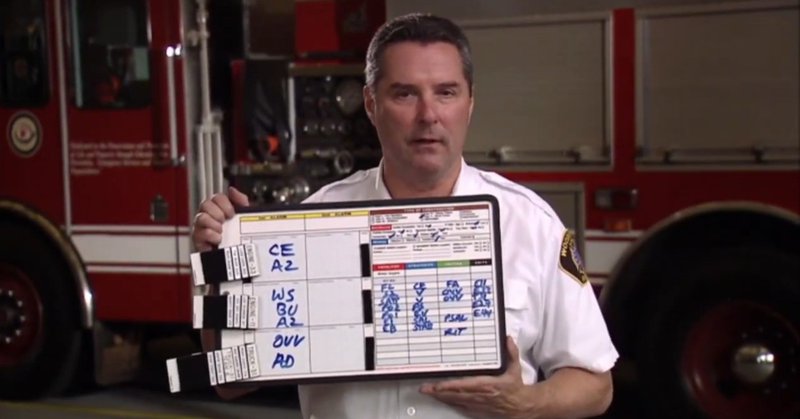
An incident command board tracks what is happening at a scene. That includes sector work, resource use, crew assignments, and apparatus status. The board sits at the command post. Because everyone on the command staff can see it, it works as a shared reference for the whole team.
Most commanders can handle a simple call from memory. That changes fast in a working incident. When multiple crews are inside, mutual aid is arriving, and conditions keep shifting, mental tracking breaks down. Instead, the board holds that picture. That frees the commander to make decisions rather than keep score. It also gives the safety officer a clear view of who is inside the hazard zone and what each crew is doing.
Magnetic Versus Dry-Erase Formats
Boards come in two main types: magnetic and dry-erase. Each works differently, and the right pick depends on how a department runs its command post.
Magnetic boards use tiles to show crews, gear, and assignments. Because the tiles move as things change, updating the board is quick and easy. Steel magnetic boards come in three sizes: 18" x 36", 23" x 31", and 30" x 40". Each one has a matted back and a frame built for field use. Black Sharpie markers, grease pencils, or dry-erase markers can also be used on these boards.
Dry-erase boards use a marker instead of tiles. Fiberglass Reinforced Plastic (FRP) boards have a surface that works with black Sharpie marker. Ink wipes off with an alcohol swab. Grease pencils and dry-erase markers can also be used on this surface. FRP boards in the 9" x 12.5" and 11" x 18" sizes also have Trim Lok rubber edges to stop breakage. In addition, IMS Alliance® recommends Sharpie brand markers for the best results on FRP.
Both types support Incident Command System (ICS) work. The choice comes down to how a department runs its post and how often the board needs to change.
Specialty Boards for Specific Operations
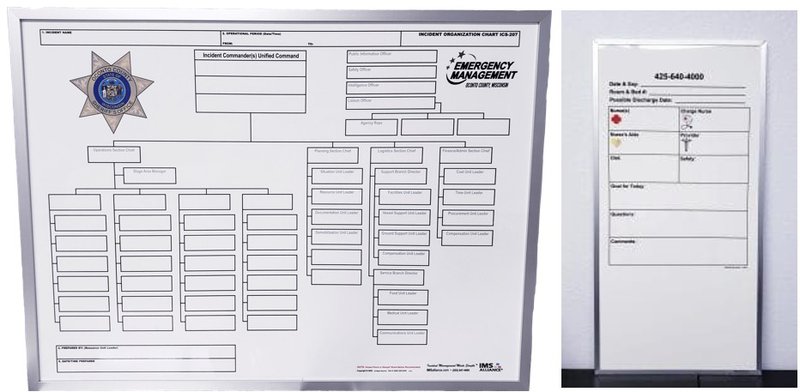
A standard board works for most calls. However, some operations need more than a blank layout. IMS Alliance® makes specialty boards for HazMat, fire, law enforcement, refineries, triage, and Aircraft Rescue and Fire Fighting (ARFF) work.
Each board comes pre-labeled for its incident type. That means the right sectors and tracking fields are already there when the board goes up. As a result, setup is faster and the risk of missing a key field drops. Similarly, having the right board on the rig removes guesswork at the post for departments that handle more than one incident type.
Custom Layouts for Department-Specific Needs
Some departments use terms that standard boards do not match. For example, a department may name sectors by local geography instead of standard ICS labels. In that case, a custom board closes the gap. IMS Alliance® builds custom boards in standard sizes, with other sizes available on request. Departments can also add a logo and set up the layout to match their own guidelines.
That kind of fit matters on a working scene. When the board reflects how the department actually runs, there is no need to translate on scene. Crews work faster and with fewer errors as a result. For that reason, custom boards are a practical choice for departments with specialized operations or non-standard ICS structures.
How the Board Works With the Rest of the Command Setup
The incident command board is one part of a full command setup. Together with accountability systems and IC vests, it gives the post a clear view of the whole scene. The accountability board shows who is inside the hazard zone. Similarly, the command board shows what each crew and sector is doing, while IC vests show who holds each command role at a glance. That matters most when mutual aid crews arrive and do not know the team.
That full setup is also what National Incident Management System (NIMS) reviewers and ISO class evaluators look for in incident documentation. Ultimately, a board in regular use builds a record of structured command work. Departments that want to set up or upgrade their command boards can contact us to learn more about standard formats, custom options, and specialty boards.


