


Incident command works differently when your department runs with twelve members instead of a hundred. Small and volunteer fire departments face the same fireground hazards as their career counterparts, but they often manage them with fewer hands, less dedicated staffing, and officers who are pulling triple duty as commander, pump operator, and accountability officer all at once. That reality does not lower the bar for command and control. It just means the system has to be built to fit the department that is actually showing up.
Why Incident Command Still Matters at Small Scale
Some volunteer officers assume incident command is built for large, multi-agency events and does not apply to a routine structure fire with three engines on scene. That thinking is one of the more dangerous misconceptions in the fire service. Command structure exists to answer a few simple questions at every incident: who is in charge, who is doing what, and where is everyone right now. Those questions matter just as much on a two-alarm barn fire in a rural district as they do at a major disaster.
The National Incident Management System was built to give every level of responder, from a single volunteer company to a federal task force, a shared framework for exactly this purpose. According to the U.S. Fire Administration, NIMS guides governmental agencies, nongovernmental organizations, and the private sector toward a shared vocabulary and process for managing incidents of any size. A small department does not need the full multi-branch org chart on a routine call. It needs the same underlying discipline, scaled down to fit the crew on scene.

The Real Challenges of Incident Command in Small Departments
Volunteer and small combination departments face unique pressures that career departments with larger staffs rarely experience in the same way.
- Limited personnel on the initial response. When only four or five members arrive within ten minutes, the first officer often manages several responsibilities simultaneously. They may establish command, assess the structure, and begin operations. No immediate backup is available to assume any of those roles.
- Multitasking incident commanders. In many volunteer settings, the incident commander also manages radio traffic, mutual aid, and crew locations. A dedicated accountability officer may not be available. This creates a well-documented risk factor. A physical command board and accountability system help close that gap. They give one person a fast, visual way to track assignments. The incident commander no longer has to keep every detail in mind.
- Inconsistent training levels. Volunteer rosters mix members with decades of fireground experience and newer recruits who are still working through basic certifications. A command system must be simple enough for everyone to use correctly under stress, not just experienced officers.
- Mutual aid complexity. Small departments lean heavily on neighboring agencies. When a mutual aid company arrives, they need to plug into command immediately, which only works if the host department's system is standardized and easy for an outside crew to read at a glance.
Building a Command System That Fits Your Department
The starting point is training. NIMS courses such as ICS-100, ICS-200, and IS-700 give officers a shared operational foundation. Many states widely require these courses. Completing them is the first real step toward building a workable local system.
From there, departments must adapt that training to their call volume, staffing patterns, and geography. A rural department covering forty square miles needs a different command approach than a suburban combination department. The rural department may operate two staffed stations with limited personnel. Meanwhile, the suburban department may handle high call volumes with consistent daily staffing.
A few practices tend to make the biggest difference for smaller organizations:
- Standardize command transfer. Every officer should use the same verbal format to pass command, so a transfer at 2 a.m. sounds the same as one at a busy afternoon structure fire.
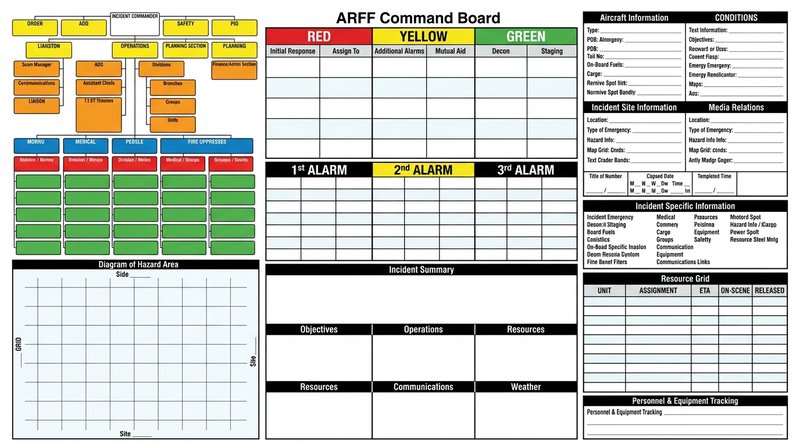
- Use a physical command board on every working incident, not just the big ones. Reserving it for major events means officers are not fluent with it when they actually need it.
- Pair command with accountability from the first unit on scene. Tracking personnel and assignments should not wait until the incident escalates. Departments that use a Passport Accountability System® build that habit into every response, so the tool is second nature by the time a fast-moving incident demands it.
- Drill on hand-off scenarios, including what happens when the first-arriving officer needs to transfer command to a chief who arrives ten minutes later.
Tools Built for Smaller Crews
Command boards designed for larger departments can be overbuilt for a company running with a handful of members per shift. Smaller departments often benefit from tools that are compact, quick to deploy, and durable enough for years of use. IMS Alliance's standard incident command boards address those needs directly. They give one officer a clear way to track units, assignments, and personnel. The system avoids adding steps that could slow an already stretched command structure.
Departments building accountability programs can explore IMS Alliance's full range of command and accountability products. The IMS Alliance blog also shows how small and volunteer departments use these tools.
Good incident command in a small department is not about mimicking a large city's org chart. It is about giving the officer in charge a simple, repeatable way to make good decisions when resources are thin, and the pressure is high. The departments that train consistently, standardize their command transfer, and build accountability into every call are the ones that keep their people safe when the call volume finally spikes.
IMS Alliance is the trademark holder of the Passport Accountability System and a veteran-owned and operated company that has spent years building mission-driven tools for incident management and personnel accountability. If your department is ready to strengthen its command and accountability program, reach out to the IMS Alliance team to talk through what fits your crew and your call volume.


