


Command boards sit at the center of every incident management operation, whether you're running a structure fire, a multi-agency training exercise, or a large-scale search operation. Choosing between magnetic and dry-erase versions might seem like a minor detail. Still, it actually shapes how quickly your team can track assignments, maintain accountability, and adapt when conditions change on scene.
Both formats have loyal followings in the fire service and emergency management world. The right choice depends on how your department operates, how often assignments shift, and how your personnel prefer to interact with the board during high-stress moments.
What Command Boards Actually Do
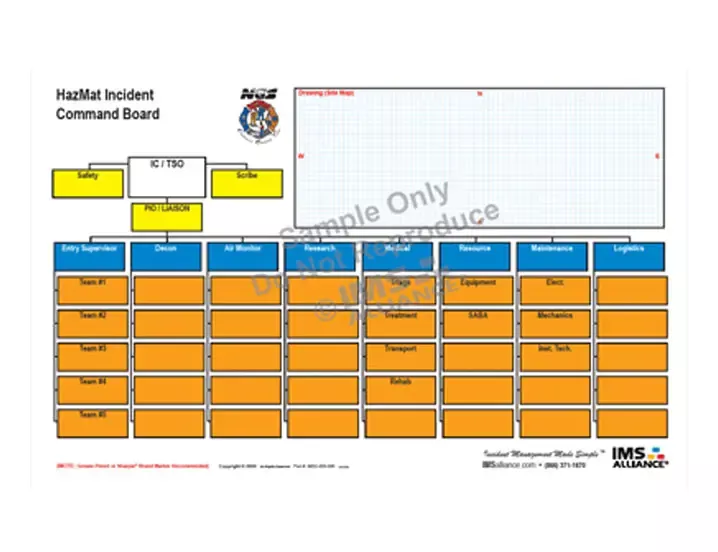
An incident command board gives an Incident Commander a visual way to track resources in real time. It organizes assignments and personnel too. Good command boards support common terminology and clarify chain of command. They help ensure every position on scene gets filled by a qualified individual. Command boards also give commanders a systematic way to identify key personnel. Commanders can do this without flipping through paperwork while an incident unfolds.
Whether you're managing a structure fire, a wildland response, or a multi-unit training scenario, incident command boards work best when they're simple to update and easy to read at a glance. That simplicity is exactly where the magnetic vs. dry-erase debate comes into play.
Magnetic Command Boards: Strengths and Trade-offs
A magnetic command board uses pre-printed magnets for unit designations, personnel names, and assignments. Commanders move magnets around the board instead of writing and erasing information by hand.
This format tends to hold up well in fast-moving incidents where assignments change frequently. Magnets are quick to reposition; they don't smear in wet or humid conditions, and they reduce the chance of illegible handwriting under pressure. Departments that run frequent multi-company operations often favor magnetic boards because reassigning a unit takes seconds.
The trade-off is flexibility for unique or one-off situations. If an incident calls for a role that isn't already on a magnet, commanders need a workaround. That might mean a blank magnet and a marker. It could also mean a supplemental notation elsewhere on the board.

Dry-Erase Command Board: Strengths and Trade-offs
Dry-erase command boards give commanders a blank canvas. Information gets written directly onto the board surface. This makes the format highly adaptable to unusual incidents or non-standard unit names. It also suits evolving operations that don't fit a pre-printed template.
This flexibility is a major advantage for smaller departments. It also helps departments handling a wide variety of incident types. Neither needs to stock multiple magnet sets. Dry-erase surfaces also tend to cost less upfront.
The downside shows up in fast-paced incidents. Writing and erasing takes longer than repositioning a magnet. Legibility can suffer when a commander works quickly or in poor lighting. Moisture and heat can also affect marker performance on scene, particularly during extended operations.
Key Factors to Weigh for Your Command Boards
A few practical questions can help departments settle on the right format:
- Incident frequency and pace. Departments running frequent multi-unit incidents often benefit from the speed of magnetic boards.
- Variety of incident types. Departments handling diverse or unpredictable incidents may prefer the openness of dry-erase surfaces.
- Personnel turnover. Magnetic tags need updating whenever staffing changes, while dry-erase boards adjust instantly with a marker.
- Environmental conditions. Extreme heat, cold, or moisture can affect either format differently, so it's worth testing before committing to a full kit.
- Training and consistency. Whichever format your department chooses, personnel need to train on it regularly so it becomes second nature during real incidents.
Many departments use a combination of both, keeping ITAC boards and other magnetic tools on hand for standard operations while relying on dry-erase surfaces for training or less predictable scenarios.
What the Standards Say About Command Boards
The National Fire Protection Association addresses incident management structure directly in NFPA 1561, its standard on emergency services incident management systems. According to the NFPA, an effective incident management system establishes clear organizational structure, accountability, and communication protocols that apply across agencies and incident types.
That standard reinforces why the physical tool matters as much as the system behind it. A command board is only as useful as its ability to reflect accurate, current information that supports safe and accountable operations.
Choosing the Right Command Board for Your Department
There's no universal answer to the magnetic vs. dry-erase question. The right command board depends on your department's call volume, incident variety, staffing patterns, and how your commanders prefer to work under pressure. Some departments even request custom configurations that blend both formats to match their specific operations.
IMS Alliance builds both magnetic and dry-erase command boards. It also builds the Passport Accountability System. Both simplify incident management without sacrificing accountability. Every board is customizable too. Departments aren't stuck choosing between a generic product and one that actually fits how they operate.
If your department is weighing which command board format makes sense, or you're ready to build a custom setup around your Passport Accountability System, send us a message today. We're happy to walk through your options and help you find a command board that works the way your crew does.


